How to Get Your Pittsburgh Restaurant Recommended by ChatGPT and Google AI
Google used to own local discovery. Now AI is taking over. If you run a Pittsburgh restaurant, the game has changed again. Your next customer might not scroll through search results at all. They might just ask ChatGPT.
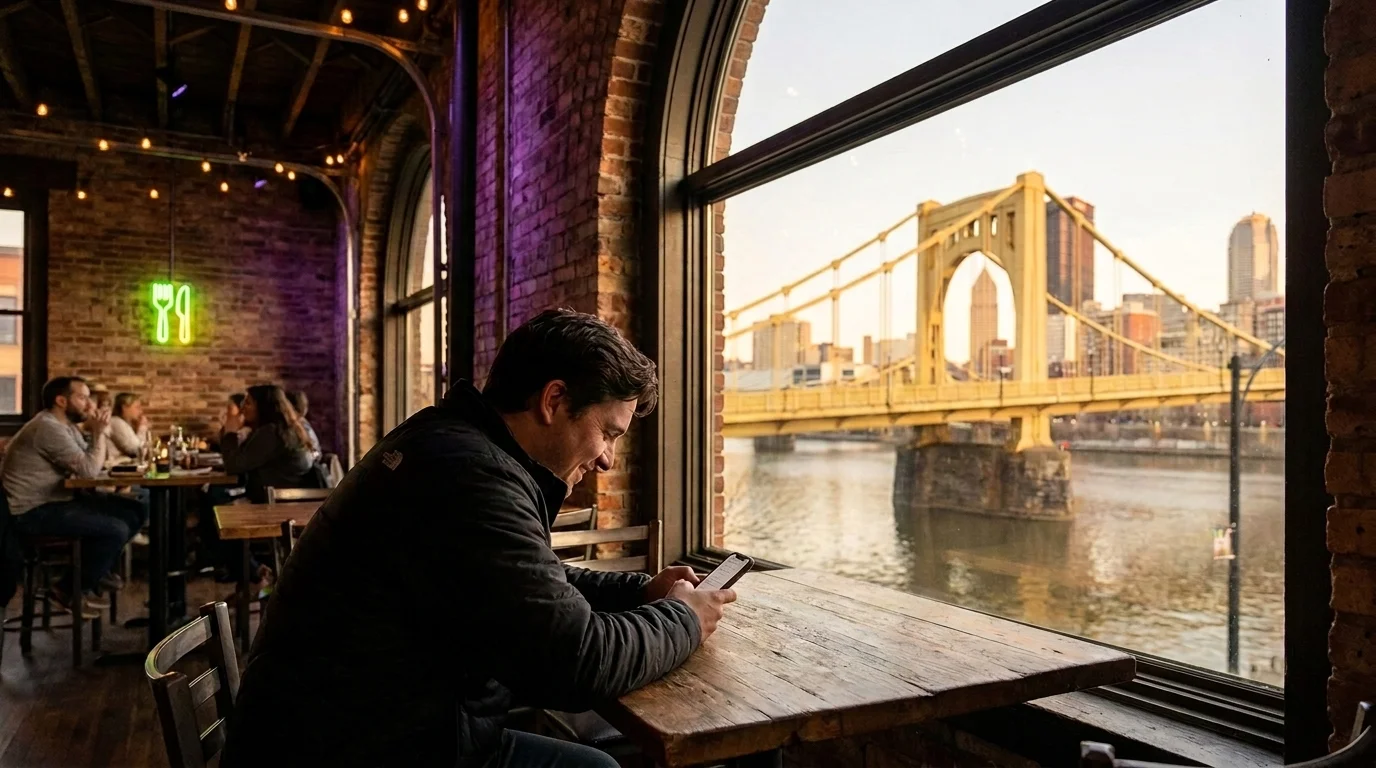
Picture this. A hungry couple in Lawrenceville opens ChatGPT and types, "Where's the best brunch in Pittsburgh?" Three restaurants pop up. The couple picks one, walks in, and orders without ever opening Google.
Now the question: was your restaurant one of those three?
If you want to get your restaurant recommended by ChatGPT in Pittsburgh, you need to understand how AI search actually works. It's not the same game as traditional Google rankings. And most restaurant owners are playing the old game while their competitors quietly win the new one.
Here's the reality. 22% of diners already use AI tools like ChatGPT to decide where to eat (DoorDash, 2026). Another 45% use AI for general local recommendations (BrightLocal, 2026). And 63% of active AI users say they trust those recommendations for local businesses.
The old model gave you 10 blue links on a search results page. You had a decent shot at showing up somewhere. The new model? ChatGPT operates as a binary system. You're either recommended consistently or you're not at all. There's no "page two." You're in or you're out.
And the customers who find you through AI are different. AI search traffic converts at 14.2%, compared to 2.8% for traditional Google organic (Semrush, 2026). That's five times better. These aren't browsers. They're buyers.
Pittsburgh diners in Shadyside, the Strip District, and Squirrel Hill are already asking ChatGPT and Google AI where to eat. If you're not showing up in those answers, you're losing customers you'll never even know about.
Why Most Pittsburgh Restaurants Can't Get Recommended by ChatGPT
Here's the uncomfortable truth. According to Local Falcon, 83% of restaurants lack the signals that AI tools need to make a recommendation. That means most Pittsburgh restaurants are completely invisible to ChatGPT and Google AI.
Why? Because AI doesn't just look at your Google ranking. It reads the entire internet. It pulls from your reviews, your social media, your website, your Google Business Profile, and every mention of your restaurant anywhere online. Then it decides if it has enough confidence to recommend you.
Most restaurants have massive gaps. Their Google Business Profile hasn't been updated in months. Their last review is from February. Their Instagram went quiet three weeks ago. Their menu isn't even on their website.
AI sees those gaps and moves on. It recommends the restaurant down the street. The one with 12 fresh reviews, an active TikTok, and a blog post from a local creator last week.
And this matters more than ever. 78% of restaurant-related searches now trigger Google AI Overviews. In Google's AI Mode, 93% of searches end without a single click to an external website. If you're not in the AI answer itself, you're invisible.
What ChatGPT and Google AI Actually Look For
You might have heard the term AEO, or Answer Engine Optimization. Sounds technical, but the concept is simple. It's about making your restaurant easy for AI to find, understand, and recommend.
Here's what AI tools are scanning for:
Fresh, detailed reviews (and lots of them). This is the biggest factor. AI-recommended restaurants average 3,424 Google reviews, compared to 955 for similar non-recommended restaurants. That's a 3.6x gap (MyPlace, 2026). And AI reads the actual text, not just the star rating. "The smoked brisket was incredible and the patio on Butler Street is perfect for date night" tells AI way more than "Great food, 5 stars." ChatGPT also sets a star rating floor around 4.3. Below that, you're unlikely to get recommended.
A complete Google Business Profile. Your hours, photos, menu, dietary options, price range, and location data all need to be filled out. AI can't recommend what it doesn't understand. Every empty field is a missed signal.
Structured data on your website. FAQ schema, menu schema, and local business markup help AI read your website faster. Content with proper schema markup has a 2.5x higher chance of appearing in AI answers. If your website is just a single page with your phone number, AI has almost nothing to work with.
Third-party mentions. When someone else talks about your restaurant online, AI treats it like a trust signal. Creator content, blog features, social media tags, local press. These are digital word-of-mouth, and AI loves them.
Active social presence. Consistent posting on Instagram and TikTok shows AI that your restaurant is open, active, and worth recommending. A profile that hasn't posted in a month? That's a red flag.
NAP consistency. Your name, address, and phone number need to match everywhere. Your website, Google, Yelp, Instagram, DoorDash. If AI finds conflicting info, it loses confidence in recommending you.
The key insight: AI doesn't just read your own content. It reads what everyone else says about you.
The 6-Step AEO Checklist for Pittsburgh Restaurants
You don't need a marketing degree to show up in AI search. Start with these six steps:
-
Claim and complete your Google Business Profile. Fill every single field. Add fresh photos. Update your hours. Post an update at least once a week. This is your foundation.
-
Put your full menu online. Not a PDF. Actual text with dish names, prices, and dietary tags (vegan, gluten-free, nut-free). AI can't read a blurry photo of your paper menu.
-
Get fresh reviews with specific language. Ask happy customers to mention what they ordered and what they loved. "The pierogi pizza at [your restaurant] in Lawrenceville was the best thing I've eaten all month" is gold for AI.
-
Add FAQ schema to your website. Answer common questions right on your site. "Do you take reservations?" "Is there outdoor seating?" "What are your brunch hours?" AI pulls directly from FAQ schema.
-
Post consistently on Instagram and TikTok. Twice a week, minimum. Geo-tag Pittsburgh. Use location stickers. Tag your neighborhood. This builds the geographic signals AI needs.
-
Get third-party mentions. This is the one most restaurants skip. You need other people talking about you. Creator content, food blog features, local event listings. That outside validation is what pushes AI from "maybe" to "recommend."
How Creator Visits Supercharge Your AI Visibility
Here's where everything clicks. Look at that checklist above. A single creator visit through Relay hits multiple items at once.
A local creator visits your restaurant. They try your food. They have a real experience. Then they create content.
One visit generates:
- A detailed Google review mentioning specific dishes and your location
- An Instagram Reel or TikTok geo-tagged to your restaurant
- Photos uploaded to Google Maps
- A third-party mention that lives on their profile permanently
That's three to five AI signals from a single visit. And when you're getting visits consistently, say two per month, those signals compound. AI sees a steady stream of fresh mentions, reviews, and content. It builds confidence. It starts recommending you.
This is the difference between a one-time push and a sustainable signal. Pittsburgh restaurants using Relay for Restaurants see their visibility scores climb month over month. Not because of one big campaign, but because of steady, authentic content from real local creators.
Two creator visits a month. That's all it takes to build the kind of signal stream that keeps AI recommending your restaurant.
Start Showing Up in AI Recommendations
Your next customer might not open Google and scroll through results. They might ask ChatGPT where to eat tonight. They might glance at a Google AI Overview and pick the first restaurant mentioned.
You can either be the one AI recommends, or the one it skips.
Relay connects your Pittsburgh restaurant with local creators who visit, create authentic content, and leave real reviews. Every visit builds the signals AI needs to recommend you. Plans start at $99/month, and your first creator visit is free.